The Arguenon facing the storm: how the “Saint Peter of the sands” was torn from the waves
In 1971, *L’Arguenon* and *La Marne*—two former sand-dredging vessels—were involved in a delicate rescue operation off the Chausey archipelago. At the time, they were operated on behalf of T.I.M.A.C. (an acronym for *Traitement Industriel du Maërl en Amendement Calcaire*—Industrial Processing of Maërl for Calcareous Soil Amendment), a subsidiary of the Roullier Group based in Brittany. Their role was to extract and transport marine soil amendments—such as *maërl* (a type of rhodolith, derived from the Ancient Greek *rhódon*, meaning “rose,” and *líthos*, meaning “stone”) and shell sand—which were used in the production of agricultural fertilizers. *L’Arguenon* and *La Marne* took part in the rescue efforts for the *Saint Pierre des Sables*, a vessel owned by the company Probiomer.
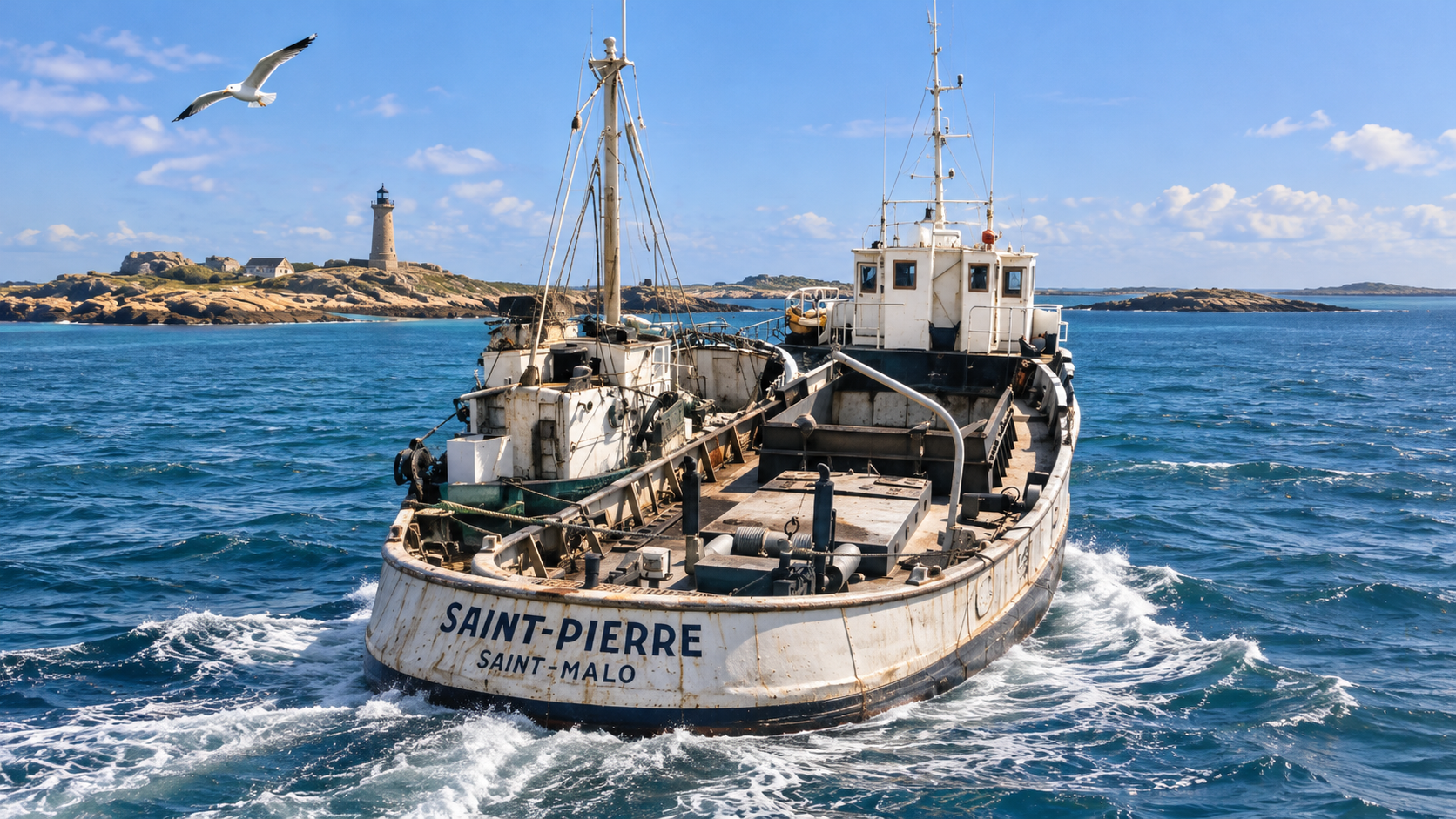
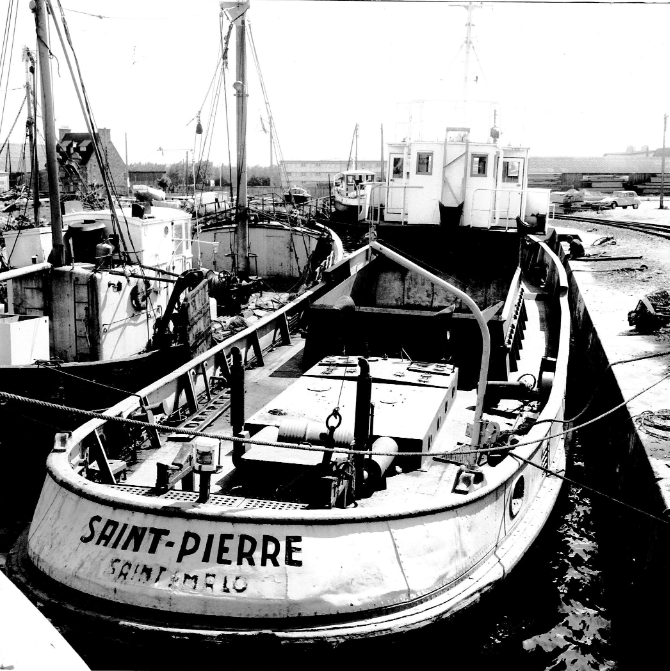
The *Saint Pierre des Sables* (“Saint Peter of the sands”) was the last sand-dredging ship authorized to operate near Chausey before it sank off the archipelago on October 7, 1971.
At the time of the sinking, the vessel’s crew consisted of four men: Captain Henri Auguste Quernec (1929–2004), a crane operator/mechanic, and two deckhands.
A few years earlier, in 1967, the 10th International Lifeboat Conference was held in Dinard and Saint-Malo, with the support of the renowned Oberthür printing house in Rennes. That same year, 1967, saw the merger of this organization with the *Hospitaliers Sauveteurs Bretons* (Breton Hospitalier Rescuers), leading to the creation of what is now the *Société Nationale de Sauvetage en Mer* (SNSM)—the French National Society for Sea Rescue. This international conference brought together maritime rescue organizations from around the world every four years. It followed the 9th edition, organized in Edinburgh (United Kingdom) in June 1963 by the Royal National Lifeboat Institution (RNLI).
These summits provided an opportunity for foreign delegations to exchange ideas on the evolution of rescue techniques, the design of unsinkable lifeboats, and operational cooperation at sea. This series of international conferences has continued over the decades, evolving into what is now the World Maritime Rescue Congress (WMRC), steered by the International Maritime Rescue Federation (IMRF). At the request of shipowner Théophile Julien Lognoné—a former watchmaker and industrialist—and various insurance companies, the firm T.I.M.A.C. (an acronym for *Traitement Industriel du Maërl en Amendement Calcaire*—Industrial Processing of Maerl for Calcareous Soil Amendment) assembled a top-tier team of about fifteen sailors and technicians to undertake the refloating of a 26-meter vessel, registered in Saint-Malo under the number SM1067.
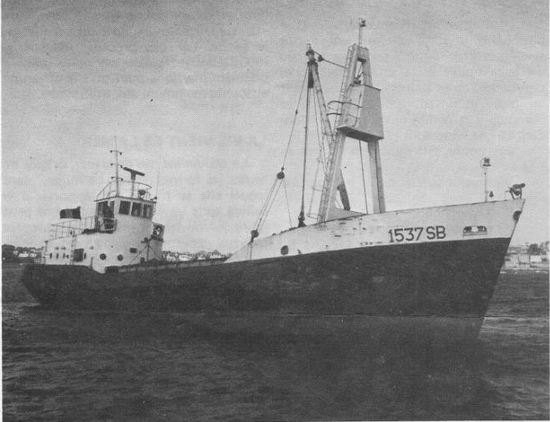
The Catherine II, another sand-dredging vessel registered in the Saint-Brieuc maritime district, which belonged to shipowner Théophile Julien Lognoné (1895–1974)
The operation was carried out in two stages. As the *Saint Pierre des Sables* was lying on its side, it first had to be righted using large tanks with capacities of 20,000 and 35,000 liters; this process, which involved pumping out the water that had filled the vessel, took three days.
In the second phase, the holds were cleared, requiring an additional day. The *Arguenon* and the *Marne*—two sand-dredging vessels belonging to T.I.M.A.C.—were employed for this work. Finally, on Tuesday evening, the *Saint Pierre des Sables* was taken in tow by the *Marne* and the *Arguenon*, passing through the large lock of the port of Saint-Malo later that evening. It was moored at its usual berth near the salt quay in the Bouvet Basin. It was in this basin that the sand-dredging vessel was photographed for the last time.
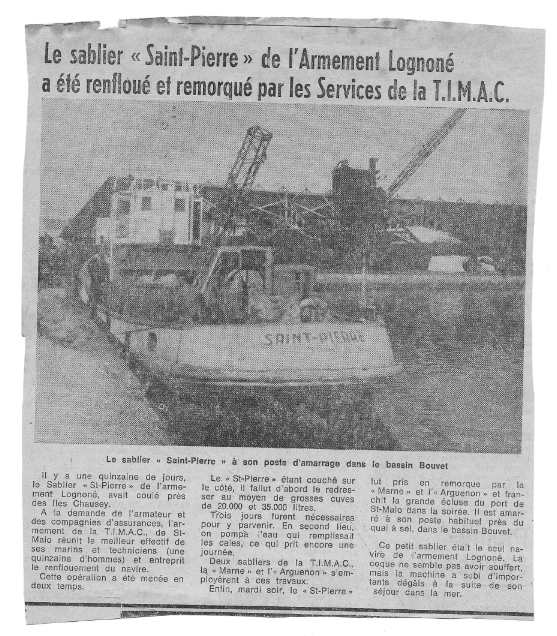
The Bouvet Basin in Saint-Malo was named in honor of Pierre-François-Étienne Bouvet de Maisonneuve—a former privateer, rear admiral, and deputy during the July Monarchy—who was born on the island of Réunion.
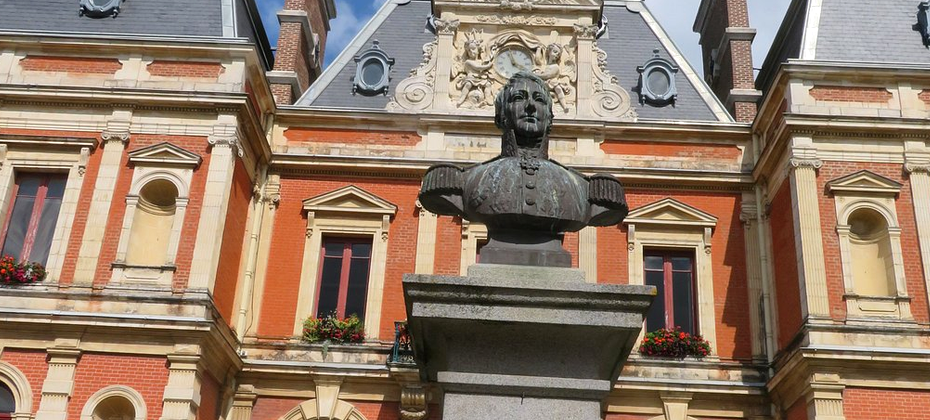
The name of the vessel *L’Arguenon* refers to the Arguenon coastal river and bay, located in the Côtes-d’Armor department—a region with a long history of maritime navigation and coastal shipping between Saint-Malo and Saint-Brieuc.