Extension of the UNESCO inscription of watchmaking know-how to a cross-Channel area
A written question has been tabled in the French Senate, at the initiative of Senator Béatrice Gosselin, concerning the theme of : the Extension of the UNESCO inscription of watchmaking know-how to a cross-Channel area.
Ms. Béatrice Gosselin drew the attention of the French Minister of Culture to the prospects for extending the inscription, by the United Nations Educational, Scientific and Cultural Organization (UNESCO), of the watchmaking and mechanical arts skills currently recognized under the Franco-Swiss Jura Arc since 2020.
Following the response given in December 2025 to a written question in the French National Assembly, it appears that extending this recognition to a cross-Channel area, including territories in the Channel, the United Kingdom, and Ireland, would be legally feasible, subject to a joint application and the prior inscription of the skills concerned in the national inventories of intangible cultural heritage.
However, Cross-Channel territories possess a significant watchmaking heritage, exemplified by the so-called “Demoiselles” clocks of Coutances, as well as long-standing historical ties with the British Isles, particularly through the Stuart heritage trails. In this context, she would like to know the concrete steps the Government intends to take regarding this prospect.
She specifically asks about potential discussions with British authorities and relevant stakeholders, the identification in France of territories and expertise that could be integrated into such an initiative, and the support the French government could offer to local authorities and professionals wishing to prepare a bid. She also wishes to know if a national coordination initiative could be launched to foster the development of a structured project.
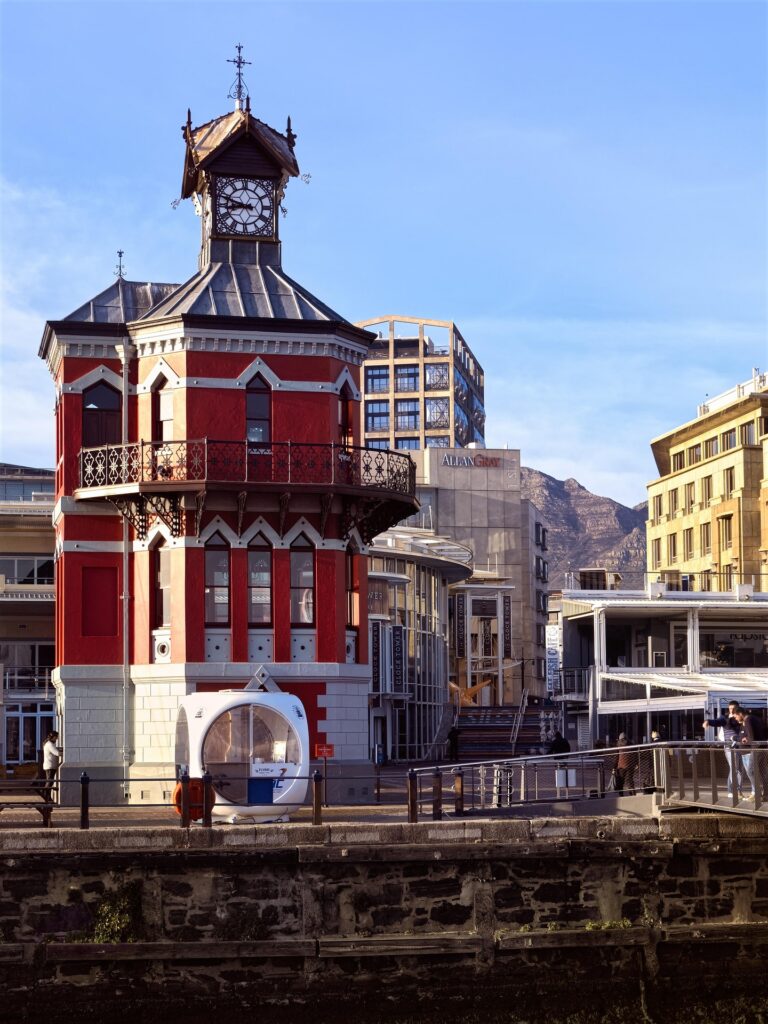
The clock at the Victoria & Alfred Waterfront in Cape Town was made in Scotland, the Jacobite land of the Stuart dynasty
Adaptation in the arts and literature
Publication of the first book on the cross-Channel watchmaking arc
The starting point for this book is an encounter with a watchmaker and repairman, Théophile Lognoné (1895-1974), who maintained a correspondence with several scientists when he founded Probiomer Industries. It is an ambitious and original work, where science and history intertwine with a family saga. It is also a captivating book for those who want to discover the little-known collaboration with the Channel Islands, particularly within the watchmaking industry. The convergence of these flows multiplies possibilities; disruption and innovation are born from this, whether in the people, ideas, or projects.
Creating an Animated Film: The Avatars of Stuart’s High Street
Imagining an animated film about clockmaking in relation to Africa might seem surprising. Yet, the Clock Tower, erected in 1882 on the Victoria & Alfred Waterfront and serving as the office of the Cape Town Harbour Master, has become a striking symbol of the city’s maritime history.
Cape Town was once the oldest continuously operating port in the Southern Hemisphere. With Table Mountain as a backdrop, the former Cunard Line ocean liner Queen Elizabeth 2 was slated to be moored near the Victoria & Alfred Waterfront, notably for the 2010 FIFA World Cup, as a floating hotel under the Dubai World project.
Another famous red clock is the recently restored City Hall clock, located on a balcony where Nelson Mandela delivered his first speech as a free man. We also think of other majestic buildings that still capture the passage of time today.
Like the House of Wonders, the palace of wonders built by the sultans of the Zanzibar archipelago. Its iconic clock, located on the bell tower of this historic monument—the largest and tallest in the old town, facing the Forodhani Gardens—illustrates how horological heritage accompanies this distinctive architecture.
This is the architecture of a palace, built by a sultan, where time never stands still, as it is a major landmark of the archipelago, reflecting the Swahili, Persian, and Arab history of Zanzibar. But ultimately, the Gothic style of the Clock Tower at the Victoria & Alfred Waterfront in Cape Town remains a truly unique landmark in Southern Africa.
A monument inspired by Gothic Europe’s cathedrals, such as Saint-Samson Cathedral in Dol-de-Bretagne, a remarkable Gothic edifice with its 13th-century stained-glass windows and, above all, its two wells, one inside and one outside, connected by an underground passage that still feeds a spring, a testament to its medieval past and local traditions.
But how? The clock at the Victoria & Alfred Waterfront in Cape Town was made in Scotland, the Jacobite land of the Stuarts.
It’s worth remembering that the Stuarts gave their name to a dynasty of sovereigns who reigned over Scotland between 1371 and 1714, as well as over England, Ireland, and Wales from 1603 to 1714. The founder of this company, Walter, was the great-grandson of Alain Dapifer, seneschal of Dol-de-Bretagne, a Breton nobleman and combatant at the Battle of Hastings (1066).
Walter Fitzalan (anglicized from Fils-Alain or Fitz-Alain), served King David I of Scotland (1124-1153) and later became High Steward of Scotland (senior official and head of the king’s household staff). Upon his death in 1177, the title of Stewart passed from father to son and gradually became a family name, which was Gallicized to Stuart.